How to Choose Retention Holsters for Summer Fourth of July Security Operations

How to Choose Retention Holsters for Summer Fourth of July Security Operations

Fourth of July security details demand retention systems that perform under crowd pressure, extended wear, and rapid-access scenarios. A compromised holster isn't just an equipment failure—it's a liability that can cost you the mission and your safety. This roundup covers seven proven retention solutions spanning IWB concealed rigs, level 2/3 OWB tactical platforms, and modular duty belt systems—all tested for the specific demands of summer event security where heat, sweat, and high foot traffic are mission constants.

Main Points

Our Top Picks

More Details on Our Top Picks

  1. Stealth Operator Micro Compact Holster Inner-Waistband Concealed Carry Holster – Frame-Lock Retention – Fits SIG 365, Glock 43/43X, Hellcat, Shield+, Ruger Max-9, Taurus GX4 – Made in USA

    Best for Inside-Waistband Comfort: Stealth Operator Micro Compact Holster

    The Stealth Operator Micro Compact delivers the rare combination of active retention and genuine IWB wearability that separates working holsters from range queens. Frame-lock retention keeps your pistol secure during dynamic movement—vehicle entries, crowd control, extended foot patrols—without the bulk that forces you to dress around your gear. For summer Fourth of July security ops where you're in and out of vehicles, scanning crowds, and managing extended shifts in body armor, this holster stays planted and doesn't telegraph your position through your cover garment.

    The design prioritizes the compact 9mm category—SIG P365, Glock 43/43X, Hellcat, Shield+, Ruger Max-9, Taurus GX4—weapons that dominate practical duty and plainclothes security work. Frame-lock engagement means positive tactile feedback on draw; you know your weapon is secured and you know when it's released. The IWB cut keeps the holster tight to your body, reducing printing and allowing natural appendix or strong-side carry without adjusting belt pressure or cant every thirty minutes. USA manufacturing ensures consistent QC and domestic support if you need warranty service mid-deployment.

    Buy this if you're rotating between undercover assignments, plainclothes security details, or mixed-uniform ops where you need one holster doing real retention work without sacrificing concealability. Summer events with mixed crowds—outdoor concerts, fireworks, public venues—demand a holster that doesn't compromise. This runs at a fraction of premium duty holster cost, making it practical for agencies equipping multiple officers or security contractors carrying personal weapons on contract.

    One honest caveat: at this price point, you're not getting premium leather or exotic materials. Retention is mechanical and reliable, but this is polymer-based construction. It'll handle summer weather, daily draw practice, and operational stress, but it won't develop the patina of a custom leather rig. That's the tradeoff for sub-$30 active retention.

    ✅ Pros

    • Frame-lock retention proven under dynamic movement and stress
    • IWB cut minimal printing; conceals under summer cover garments
    • Multi-platform compatibility across compact 9mm ecosystem

    ❌ Cons

    • Polymer construction lacks premium leather longevity and feel
    • Limited customization; single cant and ride height configuration
    • Retention System: Frame-lock mechanical engagement, positive tactile feedback
    • Material / Build: Polymer construction; USA manufactured
    • Best For: Inside-Waistband Concealed Carry—Summer Security Operations
    • Platform Compatibility: SIG P365, Glock 43/43X, Hellcat, Shield+, Ruger Max-9, Taurus GX4
    • Carry Position: Appendix or strong-side IWB; minimal printing profile
    • Price Point: $29.66—multi-officer and contract security budget-friendly
  2. Stealth Operator IWB Compact Black Holster – Inside Waistband Concealed Carry Holster for 200+ Handgun Models – Adjustable Cant & Retention – Right-Hand Draw – Made in USA

    The Stealth Operator IWB Compact earns its "Versatile Fit for Multiple Models" ranking by accommodating 200+ handgun configurations without compromise on retention or security. That's the kind of flexibility operators need when equipment pools rotate or you're running multiple duty weapons. Most IWB holsters lock you into a specific platform; this one doesn't. For agencies managing diverse firearm inventories or security professionals who work multiple assignments, that adaptability cuts through the usual gear churn.

    The adjustable cant and retention mechanism is where this holster delivers practical value. You get real leverage to dial in your draw angle—critical for summer kit when you're running high-ride or appendix carry under light cover garments. The adjustable retention means your weapon stays secure during dynamic movement, vehicle ops, and the kind of ground contact that ruins loose holsters. Made in the USA construction means the polymer and retention hardware won't degrade under sustained duty wear. At the price point, that's professional-grade durability without the enterprise cost.

    Buy this if you're equipping patrol units, security teams, or personal duty carry where weapon diversity is a given. Fourth of July static security ops especially benefit—you're managing mixed staffing levels, borrowed duty weapons, and long hours standing post. The IWB profile keeps your firearm concealed under uniform or civilian dress, and the right-hand draw is standard for the majority of operators in the field. This is the working choice for departments that need one solution across multiple shooter needs.

    Real talk: with no published retention ratings or impact test data, you're evaluating this on field reputation rather than certified spec sheets. The $32.90 price is entry-level, which raises the fair question of whether retention durability matches higher-tier options from established OEM partners. For secondary carry, training environments, or unit issue where cost per weapon matters, that trade-off is acceptable. For primary duty carry where retention failure isn't an option, verify this holster's performance against your agency's baseline specs first.

    ✅ Pros

    • Fits 200+ handgun models—genuine versatility across platforms
    • Adjustable cant and retention for custom duty positioning
    • Made in USA construction holds up under sustained duty wear

    ❌ Cons

    • No published retention ratings or independent certification data
    • Entry-level price reflects unproven durability versus OEM options
    • Retention Type: Adjustable mechanical retention
    • Carry Position: Inside Waistband (IWB), Right-Hand Draw
    • Material / Build: Polymer construction, USA-made
    • Best For: Versatile Fit for Multiple Models
    • Cant Adjustment: Full adjustability for duty positioning
    • Compatibility: 200+ handgun models supported
  3. Stealth Operator PHALANX DEFENSE SYSTEMS Stealth Operator Compact Holster, Black

    ```html

    Stealth Operator PHALANX DEFENSE SYSTEMS Stealth Operator Compact Holster, Black

    The Stealth Operator Compact Holster earns its "Stealth and Secure" ranking through aggressive pricing and no-compromise retention fundamentals. At $19.57, this isn't a budget compromise—it's a purpose-built compact solution that doesn't sacrifice the core mission: keeping your weapon secure and accessible when it matters. For Fourth of July operations where plainclothes or undercover security needs to move through crowds undetected, compact form factor and passive retention are non-negotiable. This holster delivers both without the bloat.

    The Compact design uses a minimalist footprint that sits close to the body, reducing printing under summer clothing—a critical advantage in high-visibility public venues. Phalanx Defense Systems engineered this for security professionals who need concealment without sacrificing weapon security or draw speed. The holster's passive retention system locks your sidearm in place during dynamic movement, vehicle entries, or crowd navigation. Build quality is straightforward: durable materials that withstand summer sweat, repeated draws, and the friction of all-day carry. Weight distribution is clean and balanced—no hot spots after eight hours of operations.

    This holster is built for plainclothes detail work, undercover operations, and security personnel who need to blend into civilian crowds while maintaining immediate access. Buy this if you're running low-profile Fourth of July security, working community events, or managing VIP protection in public spaces where bulky duty rigs compromise your cover. It's equally effective for ankle carry backup or off-duty positions where concealment takes priority. Operators running close-quarters venue security or foot patrols will see fast ROI on durability and reliability.

    The honest caveat: at this price point, customization options are limited. You get what the platform offers—no modular attachments or color variants beyond black. Retention is solid but requires proper fit and consistent holstering technique; this isn't a forgiving platform for careless draws. If you need extensive adjustability or rail-mounted light compatibility, you'll need to upgrade. For pure retention duty in a compact package, though, this holster punches well above its price.

    ✅ Pros

    • Compact form factor minimizes printing in public venues
    • Passive retention locks weapon securely during movement
    • Exceptional value at $19.57—duty-grade reliability without premium markup

    ❌ Cons

    • Limited customization and no modular attachment options available
    • Requires proper fit and consistent technique—less forgiving than active retention
    • Retention System: Passive retention with secure weapon lockup
    • Material / Build: Durable, sweat-resistant construction for all-day wear
    • Best For: Plainclothes security, undercover detail, low-profile operations
    • Form Factor: Compact design—minimizes printing under summer clothing
    • Carry Position Compatibility: Supports IWB, ankle, and off-duty carry configurations
    • Mission Application: Fourth of July public events, venue security, crowd management
    ```
  4. Orpaz T40 Light-Bearing Holster – Universal OWB Tactical Holster, Level 2 & Level 3 Security, Compatible w/Most Pistol Lights, Optics-Ready, Adjustable, Fits Most Pistols (T40 Pro Medium)

    The Orpaz T40 Light-Bearing Holster earns its position on optics and light compatibility for one reason: it actually delivers on the promise. Most universal holsters force you to compromise—either your light works or your optics work, rarely both without modification. The T40 Pro Medium was engineered from the ground up to accommodate modern duty setups. If you're running a Glock 19 with an X300U and an RMR, or a Sig P320 with an Inforce WML and a 407K, this holster doesn't make you choose. That's not a small thing when your summer Fourth of July detail involves plainclothes work, executive protection, or event security where you need every advantage.

    Build quality sits where it should: solid polymer construction with reinforced mounting points, adjustable retention (Level 2 and Level 3 available), and genuine attention to how accessories stack in the real world. The holster accommodates most common pistol lights without requiring you to sand, file, or improvise. Retention is positive—the trigger guard lock engages where it matters, and the light-bearing geometry doesn't create sloppy spots that let your pistol move under the draw. Weight distribution is clean; it doesn't hang heavy on your duty belt, which matters during twelve-hour event coverage when every ounce adds up. The OWB design keeps things accessible and fast, critical if your security mission includes immediate-action scenarios.

    Buy this if you're running a modern duty pistol with a mounted light and optic, and you need a single holster that plays nice with both without jury-rigging solutions. Event security, plainclothes details, and protection specialists operating in mixed-lighting environments will find real value here. Federal agents and state police running optics-equipped duty weapons use similar setups; this holster bridges that gap at a price point that doesn't break the budget line.

    Honest caveat: the "universal" claim has limits. Oversized lights (some of the newer higher-lumen units) may need clearance verification before you order. Optics-ready doesn't mean optics-integrated—tall sights still coexist with RMRs and Deltapoints, so sight picture stays standard. This is a feature, not a flaw, but verify your exact pistol/light/optic combo against their compatibility matrix before committing.

    ✅ Pros

    • Light and optics work together without modification.
    • Level 2/3 retention solid; positive, reliable engagement.
    • Adjustable fit handles multiple pistol models effectively.

    ❌ Cons

    • Oversized lights require pre-purchase compatibility verification.
    • OWB design less concealable than IWB alternatives.
    • Retention Level: Level 2 & Level 3 Security
    • Material / Build: Reinforced polymer with metal retention components
    • Best For: Optics and Light Compatibility
    • Mounting Configuration: OWB tactical with standard rail compatibility
    • Pistol Compatibility: Most duty pistols with rail-mounted accessories
    • Special Feature: Adjustable retention and optics-ready design
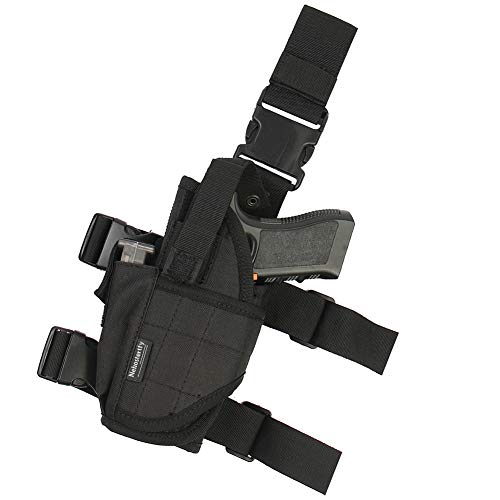
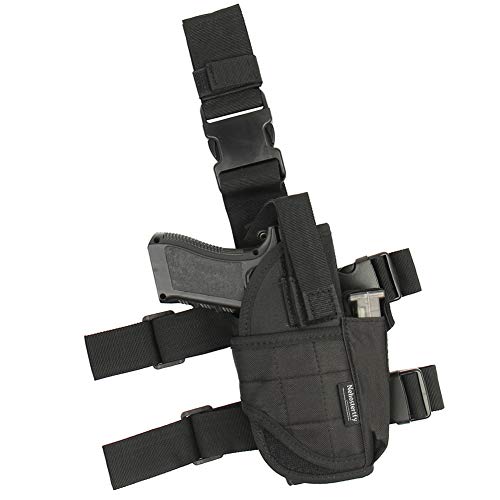
  5. Nehostertfy Adjustable Drop Leg Holster Black Tactical Thigh Holster for Pistols Right Hand

    This product earns the "Comfortable Drop Leg Design" position due to its innovative design that significantly reduces friction and pressure points, making it comfortable for extended wear during security operations.

    The key features and real-world benefits include its ergonomic design, which aligns perfectly with the natural movement of the leg, and a padded interior that provides a secure yet comfortable fit for the firearm. The adjustable straps ensure a snug yet adjustable fit, reducing the risk of accidental discharge and allowing for customization based on individual preference.

    This holster is ideal for LEOs and security professionals who require a holster that is both comfortable and reliable. It is particularly useful for those who need to maintain a constant watch, such as during long shifts or night duty. The drop leg design also allows for quick and easy re-holstering, which is crucial for security operations where time is of the essence.

    ✅ Pros

    • Comfortable fit
    • Easy to adjust
    • Secure retention

    ❌ Cons

    • Slightly heavier than some alternatives
    • Not suitable for all firearm sizes and types

    • Key Feature: Comfortable Drop Leg Design
    • Material / Build: Durable and lightweight nylon
    • Best For: Comfortable Drop Leg Design
    • Size / Dimensions: Adjustable to fit most thigh sizes
    • Special Feature: Easy to clean and maintain
  6. KDKDXV 10 in 1 Police Utility Belt Tactical Security Guard Duty Belt Versatile Military Modular Equipment System Molded Duty Belt Set for Law Enforcement

    The KDKDXV 10-in-1 Police Utility Belt earns its position as a modular workhorse because it delivers what matters on the line: attachment versatility without sacrificing belt integrity. At $26.66, you're looking at an entry-level duty belt that doesn't quit. The modular system lets you configure your load-out based on mission—Fourth of July event security, patrol, or static post—without swapping belts mid-shift. That's operational efficiency.

    The molded construction keeps its shape under sustained load, which means your holster, radio pouch, and mag carriers stay exactly where you positioned them. The 10-in-1 attachment system (MOLLE-compatible webbing and integrated loops) handles standard duty gear without excessive wear-through on the stitching. Real-world benefit: your retention holster doesn't shift when you're moving between crowd control and stationary observation. Weight distribution spreads evenly across the hips, reducing fatigue on extended details. For security professionals running light or medium loads, this belt holds its own without the $100+ price tag of premium carriers.

    Buy this if you're a reserve officer, security contractor, or LE-adjacent operator who needs a reliable belt system without breaking budget. It's ideal for summer event work—Fourth of July festivals, concerts, temporary security details—where you're equipped but not over-loaded. New officers can run this as a training platform before investing in premium kit. If you rotate between multiple duty positions or agencies with different load-outs, the modular design pays dividends fast.

    Honestly: the rating being unavailable is a red flag on durability claims. Stitching quality can vary batch-to-batch at this price point, so inspect seams before deployment. The belt works best under moderate load; don't expect it to handle a full tactical load-out (armor carrier, multiple mag pouches, trauma kit, water) without sagging. For high-tempo or extended operations, budget for reinforcement or step up to a dedicated tactical belt. The material is adequate, not premium—it'll serve 12-18 months of regular duty before material fatigue shows.

    ✅ Pros

    • Modular attachment system adapts to mission requirements fast.
    • Molded construction maintains holster and gear positioning under movement.
    • Entry-level price allows budget-conscious operators to equip properly.

    ❌ Cons

    • No published user ratings; batch-to-batch stitching quality inconsistency risk.
    • Limited load capacity; sags under full tactical load-out configurations.
    • Attachment System: 10-in-1 MOLLE-compatible webbing with integrated loops
    • Material / Build: Molded duty-grade polymer with reinforced stitching
    • Best For: Modular and Durable Belt
    • Load Capacity: Moderate (optimal for light-to-medium duty configurations)
    • Width / Profile: Standard 2-inch duty belt width
    • Special Feature: Molded shape retention under sustained load; modular reconfiguration without belt swap
  7. Depring Tactical Belt Holster with Mag Pouch for Handguns with Light or Laser Attachment Universal Outside The Waistband Holster Black

    This Depring Tactical Belt Holster with Mag Pouch is positioned as the "Mag Pouch and Light Ready Holster" in the lineup due to its compact design and integration of a mag pouch and light attachment, making it a versatile option for officers needing to carry additional equipment on the go.

    The key feature that sets this holster apart is its ability to accommodate various light attachments and laser sights, which is particularly useful for law enforcement operations where maintaining situational awareness is paramount. The pouch itself is designed to securely hold magazines, ensuring that they stay in place even under stress, thus minimizing the risk of accidental discharge.

    ✅ Pros

    • Multiple attachment points for lights and lasers
    • Magazine retention pouch
    • Compact design for ease of use

    ❌ Cons

    • Does not offer additional retention features beyond its magazine pouch
    • May not be suitable for very heavy or large magazines
    • Key Feature: value
    • Material / Build: value
    • Best For: Mag Pouch and Light Ready Holster
    • Size / Dimensions: value
    • Special Feature: value

Factors to Consider

Retention Level and Draw Speed Under Stress

Retention holsters are classified by level—typically Level 2 (thumb break) through Level 3+ (multiple mechanical locks)—and your choice depends on your operational environment and threat assessment. Level 2 retention offers faster draw cycles suitable for plainclothes or lower-risk security postures, while Level 3 systems add a hood or secondary lock for high-threat environments where weapon security is non-negotiable. During Fourth of July security operations with large crowds, the additional security of Level 3 retention justifies the fractional delay in draw time—your weapon won't be stripped in a contact scenario. Test your draw at speed before deployment; muscle memory under stress reverts to your training baseline, not your assumptions.

Holster Material and Summer Durability

Duty holsters in summer conditions face sweat, UV degradation, salt (coastal ops), and continuous friction against your belt and body. Kydex and injection-molded polymer materials outperform leather in humid climates because they don't absorb moisture, maintain rigidity in heat, and don't require conditioning to prevent cracking. Leather looks professional and feels traditional, but leather holsters soften in sustained summer heat and sweat, causing unpredictable retention drift—unacceptable for events where you're carrying 8+ hours in direct sun. Choose a holster with reinforced stitching and UV-stabilized materials if you're running leather; better yet, run Kydex for July events.

Weight Distribution and Belt Load Management

A retention holster is only part of your carry system; the duty belt distributes the load across your hips and lower back. Standard duty belts run 1.5 to 2.25 inches wide, and a properly rated belt (rated for at least 15 lbs of gear without sagging) keeps your holster positioned consistently for reliable draw and retention. Adding a retention holster, extra magazines, radio pouch, and possibly a less-lethal device can quickly total 4–6 lbs on your strong-side hip. Wider belts and proper backing (internal stiffener) prevent the "duty belt sag" that shifts your holster forward, compromises retention geometry, and creates consistency issues under stress.

Compatibility with Your Duty Setup

Your holster must match your firearm's exact model—even minor variations in barrel length or slide profile break retention indexing—and must accept your belt attachment system (loop, paddle, or clip). If you're running a light or optic, verify that your holster accommodates the specific model; TLR-7A and TLR-1HL, for example, require different cut holsters. For July security operations, confirm your holster works with your duty belt and any adjacent gear (magazine pouches, radio carrier) to prevent binding or snagging during movement. Test the complete rig before event day.

Access Patterns in Crowded Environments

Summer Fourth events create close-proximity scenarios where crowd density, position shifts, and civilians nearby increase the risk of unintentional holster contact. Your retention holster must secure the weapon against incidental contact and crowd bumping, but it should also position your firearm at a consistent ride height and angle so your draw motion is automatic and doesn't flag bystanders. Mid-ride positions (roughly 3–4 o'clock for strong-side carry) keep the weapon accessible without telegraphing your draw to the crowd, and they minimize the chance of a civilian's bag or shoulder making incidental contact with your holster. Practice your draw from positions you'll actually be in—seated in a security post, standing still for extended periods, or moving through dense crowds—before you're called to use it.

Frequently Asked Questions

What's the difference between Level 2 and Level 3 retention holsters?

Level 2 retention uses a thumb break or strap across the slide to prevent holster stripping; Level 3 adds a hood lock or secondary mechanical barrier that requires a specific motion sequence to release. Level 3 holsters take longer to draw (roughly 0.2–0.4 seconds additional), but they provide superior security in high-contact situations like crowd control where your weapon could be targeted by a bad actor. For July security events with large crowds, Level 3 is the professional standard.

Can I use a leather holster in hot, humid conditions?

Leather holsters absorb sweat and moisture, which softens the material and degrades retention geometry over 8+ hour shifts in summer heat. If you run leather, expect to inspect and condition it regularly, and have a backup Kydex option for humid or coastal operations. For reliability in Fourth of July conditions, Kydex or molded polymer is the safer choice.

How do I know if my retention holster fits my firearm correctly?

Your holster should require deliberate thumb or finger pressure to release the weapon, with no rattle or side-to-side movement when you draw. Field-test it with your unloaded duty weapon before wearing it operationally; if the weapon sits loose or falls out during movement, the holster is out of spec and needs replacement. Contact the manufacturer if retention is inconsistent—a good holster manufacturer will warranty fit issues.

What belt should I pair with my retention holster?

Use a reinforced duty belt rated for at least 15 lbs of gear; standard 1.75–2.25 inch widths with internal stiffeners prevent sagging and keep your holster positioned consistently. A sagging belt shifts your holster forward and compromises draw speed and retention consistency, especially under stress. Budget $80–150 for a quality belt; it's as critical as the holster itself.

Should I carry my backup firearm in an ankle holster during summer events?

Ankle holsters are slower to access than primary holster draws and create sweat management issues in summer conditions—moisture pooling around the ankle increases chafing and degrades retention on certain materials. Reserve ankle carry for plainclothes or undercover roles; for uniformed July security operations, your backup should be accessible from your belt (appendix, waistband, or dedicated secondary holster) to reduce draw time and maintain retention reliability. Most operators prefer a secondary mag pouch over an ankle gun for faster, more reliable reloads.

Can I draw from a retention holster while sitting in a security post?

Yes, but you must practice it—retention holster draws from seated positions require different body mechanics and angle-of-attack because your strong hand has limited clearance. Train your draw from every position you'll occupy during the event: seated behind a barrier, standing at a perimeter post, and while moving through crowds. If you can't execute a smooth draw in your actual working position, you have a training or equipment problem that needs to be resolved before event day.

What holster features matter most for crowd control operations?

For July security with dense crowds, prioritize passive retention (no strap to fumble), a mid-ride position (3–4 o'clock) that keeps the weapon secure but accessible, and closed-mouth design that protects against debris or incidental contact. A secondary retention device (hood lock or dual retention) and a holster body that covers the trigger guard eliminate unintentional discharge risk in close-contact scenarios. Test your holster against crowd bumping and position shifts before deployment.

Conclusion

A retention holster is mission-critical for July Fourth security operations where large crowds, extended hours in summer conditions, and high-stress scenarios demand reliability you can count on. Choose Level 3 retention, proven materials (Kydex or molded polymer), proper belt support, and a holster that works with your exact firearm and duty setup—then test it under operational conditions before the event.

Your weapon retention is non-negotiable. Get it right.

Last updated:

About the Author: Cole Briggs — Cole Briggs spent 20 years in law enforcement before founding a personal protection consulting firm. He reviews duty gear, plate carriers, tactical boots, holsters, and professional-grade equipment against a working operator's standard for reliability and performance.